How Do You Answer ACT English Add or Delete Questions?
To answer an ACT English add or delete question, first name what the paragraph is about, then keep the sentence only if it supports that focus right where it sits, and finally pick the choice whose reason is actually true, not just the right Yes or No.
Students often ask how to handle the ACT English questions that say a writer is thinking about adding or deleting a sentence. Many test prep sites call these add or delete questions. They feel like opinion questions, but they follow one rule you can practice: does this sentence help this paragraph do its job?
What Are ACT English Add or Delete Questions?
They are questions about whether a sentence belongs in a passage. ACT's English test description says the English section puts you in the position of a writer who revises and edits a text, and that some questions ask about a section of the passage or the passage as a whole, not just an underlined word. These questions fall under a reporting category ACT calls Production of Writing, which includes evaluating the relevance of material in terms of a text's focus (checked at act.org on November 16, 2026).
| ACT English reporting category | Approximate share of the section |
|---|---|
| Production of Writing (purpose, focus, organization) | 38 to 43 percent |
| Knowledge of Language (precise, concise wording and consistent tone) | 18 to 23 percent |
| Conventions of Standard English (grammar, usage, punctuation) | 38 to 43 percent |
Checked at act.org on November 16, 2026. ACT's test structure page lists the English section as 50 questions (40 scored) in 35 minutes, which works out to about 42 seconds a question. That is why a quick, repeatable method matters more than rereading the whole passage.
How Do You Decide Whether a Sentence Belongs?
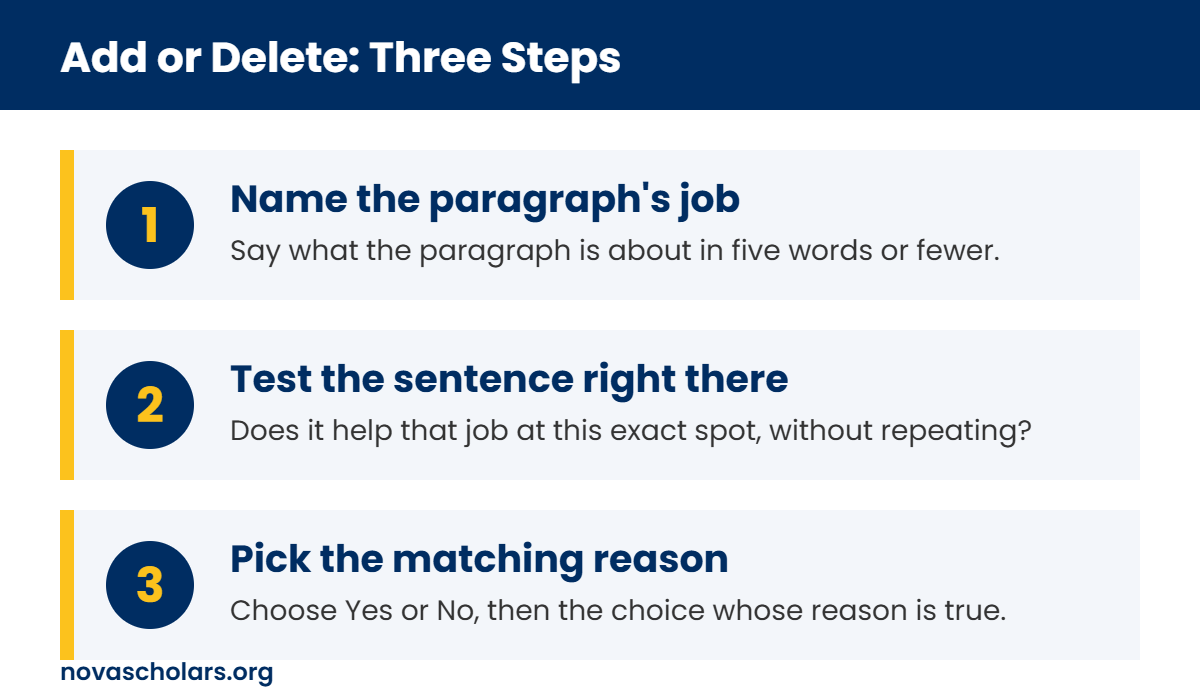
Use the same three steps every time:
- Name the paragraph's job. Before you look at the choices, say what the paragraph is about in five words or fewer, for example "how the club grew tomatoes."
- Test the sentence right there. Ask whether the sentence helps that job at that exact spot. A sentence can be true and interesting and still not belong, and a sentence that repeats something the paragraph already said adds nothing.
- Pick the matching reason. Decide Yes or No first, then read only those two choices and pick the one whose reason describes what the sentence really does.
The same steps work when the question asks what the paragraph would lose if a sentence were deleted: name what the sentence does for the paragraph, then find the choice that says exactly that.
What Traps Hide in the Answer Choices?
In my teaching, three wrong-answer patterns show up again and again on these questions:
- True but off topic. The sentence is accurate, but it drifts to a different subject. Accuracy is not the test; focus is.
- Right Yes or No, wrong reason. Two choices usually agree on Yes or No. Only one of them gives a reason that matches the sentence, so finish the job after you decide.
- A reason that describes a different sentence. The choice says the sentence "explains why" or "repeats the date," but the sentence does no such thing. Check the reason against the actual words.
Try It: Two New Practice Questions
These were written for this post. Read the short paragraph, then answer both questions.
(1) Last spring, the students in a school science club turned an empty lot behind the public library into a vegetable garden. (2) Before planting, they tested the soil and learned it needed more compost. (3) Each Saturday, two club members watered the beds and recorded how tall the tomato plants had grown. (4) By July, the garden had produced enough tomatoes to share with a nearby food pantry.
1. The writer is thinking about adding this sentence after Sentence 3: "The library was built in 1962 and has a large reading room on its second floor." Should the writer add it?
A. Yes, because it tells readers where the garden is located.
B. Yes, because it explains why the club chose the empty lot.
C. No, because it shifts the focus from the garden to the library building.
D. No, because it repeats the date the garden was started.
Answer: C. The paragraph's job is how the club grew its garden, and the new sentence is about the building. A is the "true but off topic" trap: Sentence 1 already says where the garden is. B and D give reasons the sentence never does: it says nothing about choosing the lot, and 1962 is not when the garden started.
2. If the writer deleted Sentence 2, the paragraph would mainly lose:
F. a detail showing the club prepared the soil before planting.
G. an explanation of why the food pantry needed tomatoes.
H. the season when the club began the garden.
J. a description of the library's reading room.
Answer: F. Sentence 2 is the only place the paragraph shows the club getting the soil ready. H is in Sentence 1, not Sentence 2, and G and J are not anywhere in the paragraph.
Sources
- ACT, English Test Description for the ACT (the writer's role, questions about a section or the whole passage, Production of Writing and its share, relevance to a text's focus). Checked November 16, 2026.
- ACT, What's on the ACT Test? Exam Sections and Structure (English: 50 questions, 40 scored, 35 minutes; category shares). Checked November 16, 2026.
- The three steps, the trap list, the chart, and the practice questions are Nova Scholars teaching material, not ACT content.
Want to See Where Your Student Stands?
My full-length Practice ACT runs under real ACT timing and comes with a score report: an estimated score range for each section, plus the skills and pacing to work on next. It is listed at $55, and it is as low as $5 plus Outschool's marketplace fee, shown at checkout, for families new to Outschool. Book the Practice ACT here.
Full disclosure: I get a referral reward from Outschool when a new family joins through my link.
Daa'iyah Na'im, Ed.S., is a licensed teacher and doctoral candidate researching feedback and ACT Math performance. She founded Nova Scholars, a Mississippi nonprofit, and teaches live ACT prep on Outschool.
Want the next tip in your inbox? Subscribe for free