How Do You Answer ACT Reading Paired Passage Questions?
To answer ACT Reading paired passage questions, read Passage A and answer the questions about it, then read Passage B and answer its questions, and save the questions about both passages for last, after you can say in one line what each author thinks.
Paired passages worry a lot of students because there are two texts to keep straight under a clock. The good news is that most of the questions in a paired set are about one passage at a time. Only the last few ask you to compare, and those get much easier once you have handled each passage on its own.
What Are ACT Reading Paired Passages?
They are two shorter passages on a related topic that share one set of questions. ACT's Reading test description says some parts of the section are one long passage and others are shorter passages, and that in sections with two shorter passages, some of the questions involve both of them. ACT's exam structure page lists questions that compare paired passages as part of the Reading section, and its Integration of Knowledge and Ideas category includes making connections between passages on related topics (checked at act.org on November 17, 2026).
| ACT Reading fact | What ACT lists |
|---|---|
| Questions | 36 (27 scored) |
| Time | 40 minutes, about 67 seconds a question |
| Key Ideas and Details | 44 to 52 percent of the section |
| Craft and Structure | 26 to 33 percent |
| Integration of Knowledge and Ideas (includes comparing passages) | 19 to 26 percent |
Checked at act.org on November 17, 2026. The 67 seconds is simple division (40 minutes for 36 questions), and it includes your reading time, so you cannot afford to read both passages twice.
In What Order Should You Answer Paired Passage Questions?
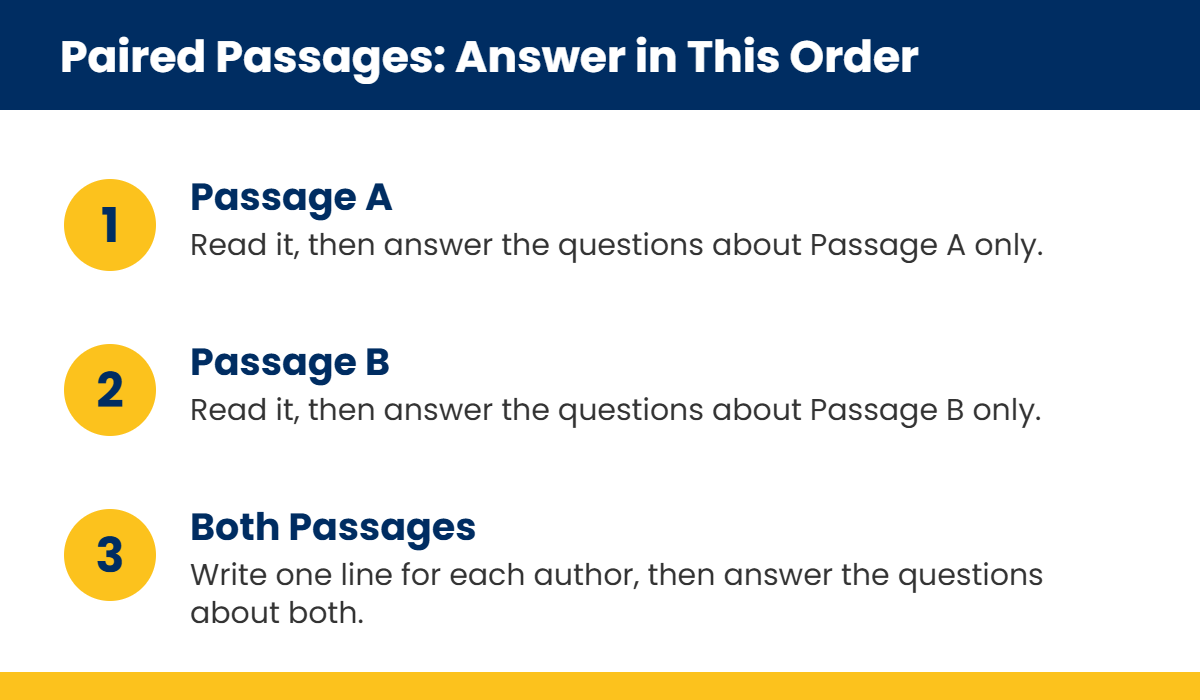
In my teaching, this order works for almost every student:
- Passage A first. Read Passage A, then answer every question that names only Passage A. Do not read Passage B yet, so the two authors do not blur together.
- Passage B next. Read Passage B, then answer every question that names only Passage B.
- Both passages last. Before you touch a question about both, write one short line for each author on your scratch paper: what the author thinks and how strongly. Then ask how the two lines relate. Do they agree, disagree, or does one give an example of the other's idea?
The questions usually tell you which passage they are about in their first words, such as "the author of Passage B" or "both passages." Glance at those words before you read so you know which questions to save for the end.
What Traps Show Up on Questions About Both Passages?
Three wrong-answer patterns show up again and again:
- True for only one passage. The choice matches one author perfectly, but the question asks what both authors would agree with. Check the choice against each one-line summary, one at a time.
- The authors swapped. The choice gives an idea that really appears, but it credits the wrong author. This is the main reason to answer the single-passage questions first.
- Too strong. One author makes a careful, limited point, and the choice turns it into an extreme one, such as "always," "never," or "entirely." Pick the choice that keeps each author's claim the same size.
Try It: Two New Practice Questions
These short passages and questions were written for this post. Read both passages, then answer both questions.
Passage A. City parks were meant to be places to slow down. Today many visitors spend their time in them looking at screens, and people who come for quiet hear one-sided phone calls instead of birds. A small change would help: mark one corner of each large park as a phone-free quiet zone. Visitors who want to talk or scroll would still have the rest of the park, and those who want stillness would finally have a place that protects it. A sign costs little, and the benefit to people who need a calm hour would be large.
Passage B. I share the wish for calmer parks, but a rule posted on a sign rarely changes how people behave. A park is not a library with a librarian at the desk. No one would be there to enforce a phone-free corner, and a rule that is ignored teaches visitors to ignore the next one too. A better approach is design. Benches turned toward trees and water, paths that curve away from the street, and plantings that soften traffic noise invite people to put their phones away on their own. Calm that people choose lasts longer than calm that is ordered.
1. The authors of both passages would most likely agree that:
A. city parks should offer visitors a calmer experience.
B. a posted rule is the best way to create quiet areas in parks.
C. phones should be banned from city parks entirely.
D. the way a park is designed has little effect on how visitors behave.
Answer: A. Passage A wants a place that protects stillness, and Passage B opens with "I share the wish for calmer parks." B is true for only one passage: Passage B rejects posted rules. C is too strong: Passage A keeps phones allowed in the rest of the park. D is the opposite of Passage B's main point.
2. How would the author of Passage B most likely respond to Passage A's claim that "a sign costs little"?
F. By agreeing that a sign is the simplest way to protect quiet.
G. By arguing that a sign would do little good with no one there to enforce it.
H. By claiming that most park visitors do not want quiet.
J. By suggesting that quiet zones belong in libraries instead of parks.
Answer: G. Passage B says no one would be there to enforce the rule and that an ignored rule teaches people to ignore the next one, so a cheap sign is not worth much. F credits Passage A's view to the wrong author. H twists Passage B, which shares the wish for calm. J misreads the library comparison, which only explains why a park rule would go unenforced.
Sources
- ACT, Reading Test Description for the ACT (long and shorter passages, questions that involve both shorter passages, reporting category shares). Checked November 17, 2026.
- ACT, ACT Exam Sections, Structure and Timing (Reading: 36 questions, 27 scored, 40 minutes; questions that compare paired passages; connections between passages on related topics). Checked November 17, 2026.
- The answer order, the trap list, the chart, and the practice passages and questions are Nova Scholars teaching material, not ACT content.
Want to See Where Your Student Stands?
My full-length Practice ACT runs under real ACT timing and comes with a score report: an estimated score range for each section, plus the skills and pacing to work on next. It is listed at $55, and it is as low as $5 plus Outschool's marketplace fee, shown at checkout, for families new to Outschool. Book the Practice ACT here.
Full disclosure: I get a referral reward from Outschool when a new family joins through my link.
Daa'iyah Na'im, Ed.S., is a licensed teacher and doctoral candidate researching feedback and ACT Math performance. She founded Nova Scholars, a Mississippi nonprofit, and teaches live ACT prep on Outschool.
Want the next tip in your inbox? Subscribe for free