Which Formulas Should You Memorize for ACT Math?
For ACT Math, your student should know a short list of basic formulas by heart (slope, the Pythagorean theorem, SOH CAH TOA, area and circle formulas, percent change, and average), because ACT says knowledge of basic formulas is assumed, while recall of complex formulas is not required.
"Does the ACT give you a formula sheet?" is a question students and parents search for often. ACT's own description of the math section does not mention one, so the safe plan is simple: know the basics cold and skip the long cheat sheets.
Does ACT Math Expect Your Student to Know Formulas?
Yes, the basic ones. ACT's description of the math section says knowledge of basic formulas and computational skills are assumed as background for the problems, but recall of complex formulas and extensive computation are not required (checked at act.org on November 13, 2026).
That matters for pacing. Looking up or rebuilding a formula in the middle of a timed section costs time your student does not have.
| Section | Questions | Minutes | Average per question |
|---|---|---|---|
| ACT Math | 45 (41 scored) | 50 | About 67 seconds |
Checked at act.org on November 13, 2026: What's on the ACT Test?
Which Formulas Should Your Student Know by Heart?
This is Nova Scholars' own short list of basic formulas that come up again and again in high school math. It is not a list from ACT, and ACT does not endorse it.
| Topic | Formula | Use it when |
|---|---|---|
| Slope | m = (y2 - y1) / (x2 - x1) | You have two points on a line |
| Line | y = mx + b | You need the slope (m) or the y-intercept (b) |
| Midpoint | ((x1 + x2) / 2, (y1 + y2) / 2) | You need the point halfway between two points |
| Distance | d = √((x2 - x1)2 + (y2 - y1)2) | You need the length between two points |
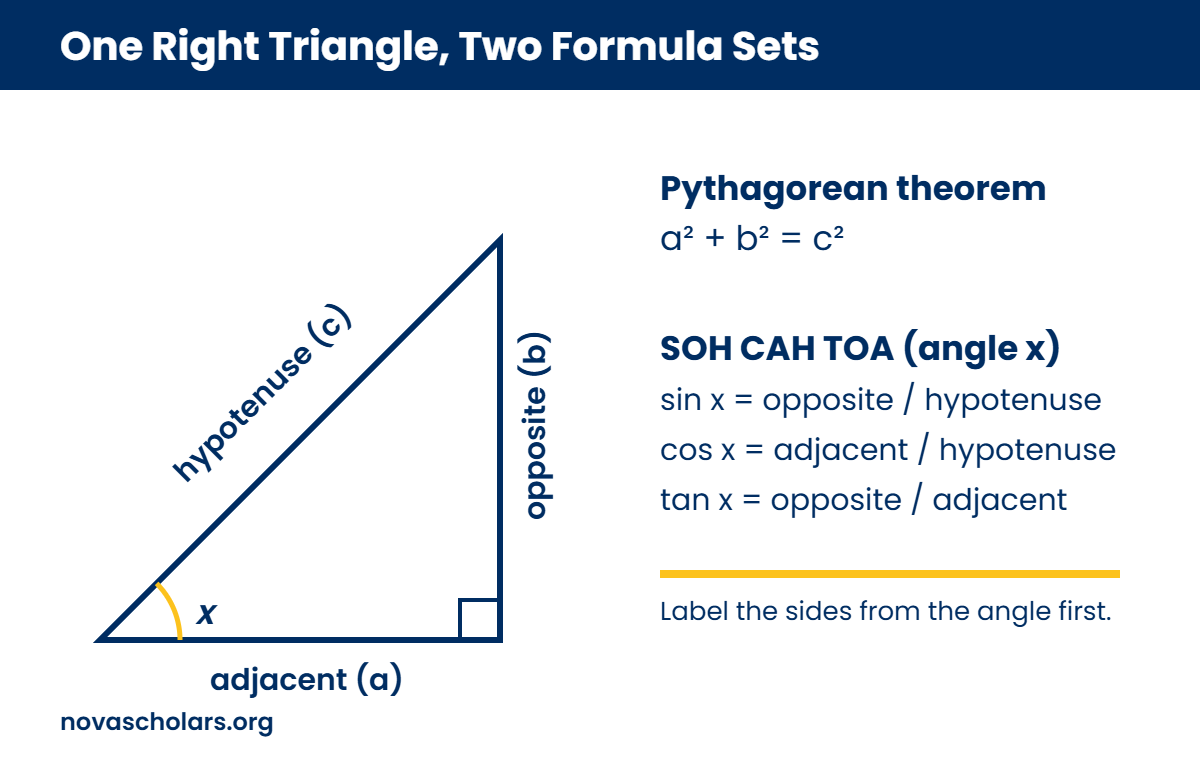
| Pythagorean theorem | a2 + b2 = c2 | A right triangle is missing a side |
| SOH CAH TOA | sin = opp / hyp, cos = adj / hyp, tan = opp / adj | A right triangle gives an angle |
| Area | Rectangle lw, triangle (1/2)bh, circle πr2 | The question asks how much space a shape covers |
| Circumference | C = 2πr | The question asks for the distance around a circle |
| Percent change | (new - old) / old × 100 | A price or amount goes up or down |
| Average (mean) | sum of values / number of values | The question gives a set of numbers or a missing score |
| Probability | favorable outcomes / total outcomes | The question asks how likely something is |
How Should Your Student Practice the Formulas?
Memorizing a list is only half the job. The other half is knowing which formula a question is asking for.
- Write the list from memory. Once a day, your student writes every formula above on blank paper, then checks it. Any formula missed goes to the top of tomorrow's list.
- Use each one on a problem. A formula your student can recite but has never used under time is not ready yet.
- Draw the picture. For geometry and trig, sketch the shape and label it before choosing a formula.
Try It: Three Practice Questions
These questions were written new for this post by Nova Scholars. They are not ACT questions.
1. A line passes through the points (2, 3) and (6, 11). What is the slope of the line?
A. 1/2
B. 2
C. 4
D. 8
Answer: B. Slope is the change in y over the change in x: (11 - 3) / (6 - 2) = 8 / 4 = 2. Choice A flips the fraction, and D forgets to divide by the change in x.
2. A right triangle has legs of length 9 and 12. What is the length of the hypotenuse?
F. 13
G. 15
H. 18
J. 21
Answer: G. By the Pythagorean theorem, 92 + 122 = 81 + 144 = 225, and the square root of 225 is 15. Choice J just adds the two legs, which never works for a hypotenuse.
3. A jacket's price rose from $40 to $50. By what percent did the price increase?
A. 10%
B. 20%
C. 25%
D. 50%
Answer: C. Percent change is (new - old) / old: (50 - 40) / 40 = 10 / 40 = 0.25, or 25%. Choice B divides by the new price, 50, instead of the old price, 40.
Can Students Use a Calculator on ACT Math?
Yes. ACT says a calculator may be used on the math section in accordance with ACT's calculator policy, and its math test tips add that all of the problems can be solved without a calculator (both checked at act.org on November 13, 2026). A calculator does not replace knowing the formulas: it only does the arithmetic once your student knows what to compute. Not sure your student's calculator is allowed? Check our ACT Calculator Policy guide.
Sources
- ACT, Description of the Math Test (basic formulas assumed; complex formulas not required; calculator allowed). Checked November 13, 2026.
- ACT, What's on the ACT Test? Exam Sections and Structure (Math: 45 questions, 41 scored, 50 minutes). Checked November 13, 2026.
- ACT, ACT Math Test Tips (all problems can be solved without a calculator). Checked November 13, 2026.
- The formula list, triangle card, and practice questions are Nova Scholars teaching material, not ACT content.
Want to See Where Your Student Stands?
My full-length Practice ACT runs under real ACT timing and comes with a score report: an estimated score range for each section, plus the skills and pacing to work on next. It is listed at $55, and it is as low as $5 plus Outschool's marketplace fee, shown at checkout, for families new to Outschool. Book the Practice ACT here.
Full disclosure: I get a referral reward from Outschool when a new family joins through my link.
Daa'iyah Na'im, Ed.S., is a licensed teacher and doctoral candidate researching feedback and ACT Math performance. She founded Nova Scholars, a Mississippi nonprofit, and teaches live ACT prep on Outschool.
Want the next tip in your inbox? Subscribe for free