How Do You Answer ACT Science Conflicting Viewpoints Questions?
To answer ACT Science Conflicting Viewpoints questions, first write a few words that sum up each person's claim, note where the claims agree and where they split, and then match each question to the viewpoint it names before you look at the answer choices.
Students often ask for the best way to handle this passage, because it reads more like an argument than an experiment. The good news: the questions never ask who is right. They ask what each person thinks and what evidence would fit or break that thinking.
What Is a Conflicting Viewpoints Passage on ACT Science?
ACT says the science section presents information in three formats. In a Conflicting Viewpoints passage, two or more people (often scientists or students) explain the same thing in different ways, and the questions compare those explanations.
| Format | What it shows | Share of the science section |
|---|---|---|
| Data Representation | Tables, graphs, and diagrams | 25 to 35% |
| Research Summaries | One or more related experiments and what they found | 45 to 60% |
| Conflicting Viewpoints | Two or more explanations that do not agree | 15 to 20% |
Source: ACT, Science Test Description, checked November 12, 2026.
How Much Time Does ACT Science Give You?
ACT Science is an optional add-on to the ACT, with 40 questions in 40 minutes. That is about one minute per question, so a slow, word-for-word read of a long argument passage costs time your student needs for the questions.
| Section | Questions | Minutes | Average per question |
|---|---|---|---|
| ACT Science (optional add-on) | 40 | 40 | About 1 minute |
Checked on November 12, 2026, at act.org: The ACT.
How Should Your Student Read a Conflicting Viewpoints Passage?
Treat it like listening to two friends disagree. Your student is the note taker, not the judge.
- Read the opening paragraph closely. It holds the facts everyone accepts, and both viewpoints build on it.
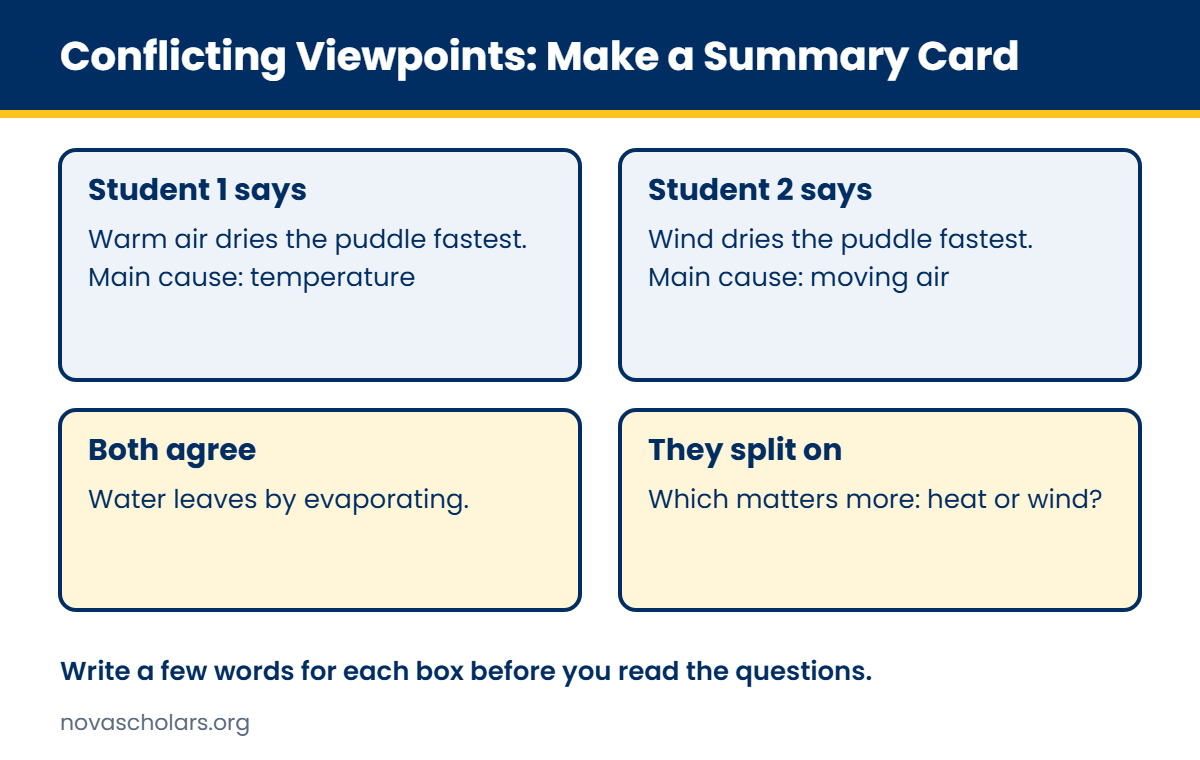
- Sum up each viewpoint in a few words. Write them in the margin: "Student 1: heat" and "Student 2: wind." Short labels keep the two views from blurring together.
- Mark where they agree and where they split. Many questions live right on that line.
- Read each question for the name it uses. If it says Student 2, reread only Student 2's paragraph, then answer from that view, even if your student thinks Student 1 is right.
Try It: Two Practice Questions
These questions were written new for this post by Nova Scholars. They are not ACT questions.
A class discussed why a puddle on the school blacktop dried faster on some afternoons than on others.
Student 1: Air temperature matters most. On warmer afternoons, water evaporates faster, whether or not the wind is blowing.
Student 2: Wind matters most. Moving air carries water vapor away from the surface of the puddle, so a puddle dries faster on a windy afternoon even when the air is cool.
1. Student 1 would most likely predict that a puddle dries fastest on an afternoon that is:
A. cool and calm.
B. cool and windy.
C. warm and calm.
D. cool and cloudy.
Answer: C. Student 1 says temperature matters most, wind or no wind, and C is the only warm choice. B is the answer Student 2 would pick, which is the trap: it answers from the wrong viewpoint.
2. Which observation, if true, would most weaken Student 2's explanation?
F. On two equally warm afternoons, one windy and one calm, two puddles dried at the same rate.
G. A puddle dried faster on a warm, windy afternoon than on a cool, calm afternoon.
H. Puddles in the shade dried more slowly than puddles in the sun.
J. At the same temperature, a puddle dried faster on a windy afternoon than on a calm one.
Answer: F. Only the wind changed in F, and the drying did not, so wind made no difference. G changes heat and wind together, so it cannot tell which one mattered. H is about sunlight, not wind. J supports Student 2 instead of weakening it.
Can Students Use a Calculator on ACT Science?
No. ACT's description of the science section says a calculator is not permitted in the science section (checked at act.org on November 12, 2026). Conflicting Viewpoints questions in particular are about reasoning, not arithmetic. Not sure your student's calculator is allowed for the math section? Check our ACT Calculator Policy guide.
Sources
- ACT, Science Test Description for the ACT (the three passage formats and their shares, and the calculator rule). Checked November 12, 2026.
- ACT, The ACT (Science: 40 questions in 40 minutes, optional add-on). Checked November 12, 2026.
- The reading steps, summary card, and practice questions are Nova Scholars teaching material, not ACT content.
Want to See Where Your Student Stands?
My full-length Practice ACT runs under real ACT timing and comes with a score report: an estimated score range for each section, plus the skills and pacing to work on next. It is listed at $55, and it is as low as $5 plus Outschool's marketplace fee, shown at checkout, for families new to Outschool. Book the Practice ACT here.
Full disclosure: I get a referral reward from Outschool when a new family joins through my link.
Daa'iyah Na'im, Ed.S., is a licensed teacher and doctoral candidate researching feedback and ACT Math performance. She founded Nova Scholars, a Mississippi nonprofit, and teaches live ACT prep on Outschool.
Want the next tip in your inbox? Subscribe for free