How Do You Answer ACT Reading Word Meaning Questions?
To answer an ACT Reading word meaning question, cover the word, reread the whole sentence, put your own plain word in its place, and pick the choice that matches your word in that sentence, not the word's most familiar meaning.
These questions look like vocabulary questions, but they are really reading questions. The word is usually one your student already knows. The challenge is that the passage uses it in a less common way, and the wrong choices often list meanings the word really can have, just not in this sentence.
What Do ACT Reading Word Meaning Questions Ask?
ACT says the reading section asks students to "determine the meaning of context-dependent words, phrases, and statements," and it also says the section does not contain isolated vocabulary questions. Word meaning sits in the Craft and Structure reporting category, which ACT lists at about 26 to 33 percent of the reading section.
| ACT Reading fact | What ACT lists |
|---|---|
| Questions | 36 (27 scored) |
| Minutes | 40 |
| Average time per question, reading included | About 67 seconds |
| Craft and Structure (includes word and phrase meanings) | About 26 to 33 percent of the section |
Checked at act.org on November 21, 2026. The time per question is our division of 40 minutes by 36 questions, and it includes the time spent reading the passages.
In plain words: a reporting category is one of the skill groups ACT uses to break down a section score on the score report.
What Is the Fastest Way to Answer a Word Meaning Question?
Use the same four steps every time, so your student does not have to decide how to start.
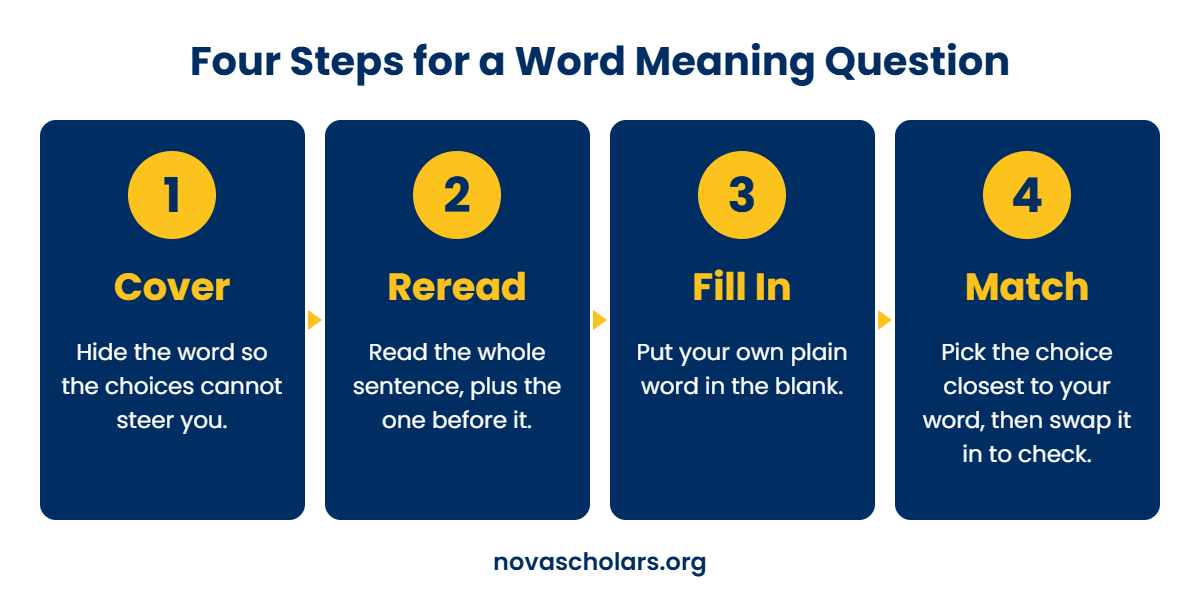
- Cover. Put a finger or the scratch paper over the word, so the answer choices cannot steer your student toward the meaning they know best.
- Reread. Read the whole sentence, and the sentence before it. The clue is often a contrast word (but, although, instead) or an example right next to the word.
- Fill in. Say a plain word that would make sense in the blank. It does not need to be fancy. "Limit" or "show" is enough.
- Match. Pick the choice closest to your plain word, then read the sentence once more with that choice in place. If the sentence still says the same thing, it fits.
Why Is the Most Common Meaning Often the Wrong Answer?
Because the question is about this sentence, not the dictionary. If a passage says a rule was meant to "check" the noise in a room, the everyday meaning, to look something over, does not fit. The sentence is about holding the noise down, so "limit" fits. A student who reads the word and jumps to the choices will often see the familiar meaning first and stop there. Covering the word and filling in your own word first is what protects against that.
Try It: Three Practice Questions
These are new questions written for this post, each with one short sentence instead of a full passage. On the real test, the sentence sits inside a longer passage, so the sentence before it matters too.
1. "From the hilltop, the old stone bridge commands a wide view of the valley below." As it is used in the sentence, the word "commands" most nearly means:
A. orders
B. overlooks
C. leads
D. demands
Answer: B. A bridge cannot give orders. The sentence is about what you can see from it, so a plain fill in word is "has" or "looks over." Choices A, C, and D are real meanings of "commands" that need a person in charge.
2. "The new library rules were meant to check the noise in the study room, not to ban talking altogether." As it is used in the sentence, the word "check" most nearly means:
F. examine
G. mark
H. limit
J. pay
Answer: H. The contrast "not to ban talking altogether" tells you the rules hold the noise down without stopping it. Choice F is the everyday meaning, and choices G and J come from a check mark and a bank check.
3. "Her first experiment was promising, but she knew one trial alone could not carry the argument." As it is used in the sentence, the phrase "carry the argument" most nearly means:
A. move the argument to a new place
B. make the argument convincing
C. repeat the argument aloud
D. hold the argument in memory
Answer: B. The word "but" signals a limit: one trial is not enough evidence. A plain fill in is "prove the point." Choice A takes "carry" in its physical sense, and choices C and D do not fit the idea of evidence.
How Can Students Practice Word Meaning Questions at Home?
Any article works. Once a day, have your student find one common word used in an unusual way (a team that "posts" a win, a plan that "stands," a price that "climbs"), cover it, and say a plain word that keeps the meaning. Then check together whether the swap still says the same thing. It takes one sentence, and it builds the habit of reading the sentence before reaching for a definition.
Sources
- ACT, Reading Test Description for the ACT (the skills list, the note on isolated vocabulary questions, and the reporting categories), checked November 21, 2026.
- ACT, ACT Exam Sections, Structure and Timing (questions, scored questions, and minutes), checked November 21, 2026.
- The four steps, the diagram, and the practice questions are Nova Scholars teaching guidance, not ACT content.
Want to See Where Your Student Stands?
My full-length Practice ACT runs under real ACT timing and comes with a score report: an estimated score range for each section, plus the skills and pacing to work on next. It is listed at $55, and it is as low as $5 plus Outschool's marketplace fee, shown at checkout, for families new to Outschool. Book the Practice ACT here.
Full disclosure: I get a referral reward from Outschool when a new family joins through my link.
Daa'iyah Na'im, Ed.S., is a licensed teacher and doctoral candidate researching feedback and ACT Math performance. She founded Nova Scholars, a Mississippi nonprofit, and teaches live ACT prep on Outschool.
Want the next tip in your inbox? Subscribe for free