How Do You Answer ACT English Transition Questions?
To answer an ACT English transition question, cover the choices, read the sentence before the underlined word and the sentence that holds it, name how the two ideas connect, and pick the only choice that does that job.
Transition words are the small words that link one idea to the next: however, therefore, for example, in addition. Students often pick the one that sounds the most formal or the most familiar. The question is simpler than that: how does this sentence relate to the one before it?
Where Do Transition Questions Show Up on ACT English?
ACT sorts English questions into three reporting categories. Production of Writing, at about 38% to 43% of the section, covers a passage's purpose, development, and organization, including how well ideas are introduced, supported, and connected. Transition questions test that last part: how one idea connects to the next.
| ACT English fact | What ACT lists |
|---|---|
| Questions | 50 (40 scored) |
| Minutes | 35 |
| Average time per question | About 42 seconds |
| Production of Writing | About 38% to 43% of the section |
| Knowledge of Language | About 18% to 23% of the section |
| Conventions of Standard English | About 38% to 43% of the section |
Checked at act.org on November 23, 2026. The time per question is our division of 35 minutes by 50 questions.
What Is the Fastest Way to Pick the Right Transition?
Teach your student three steps, in this order:
- Cover the choices. Read the sentence before the underlined word and the sentence that holds it, without looking at the choices yet.
- Name the job. Does the second idea add to the first, push against it, follow from it, or give one case of it?
- Keep only that job. Cross out every choice that does a different job, then read the one that is left back into the sentence.
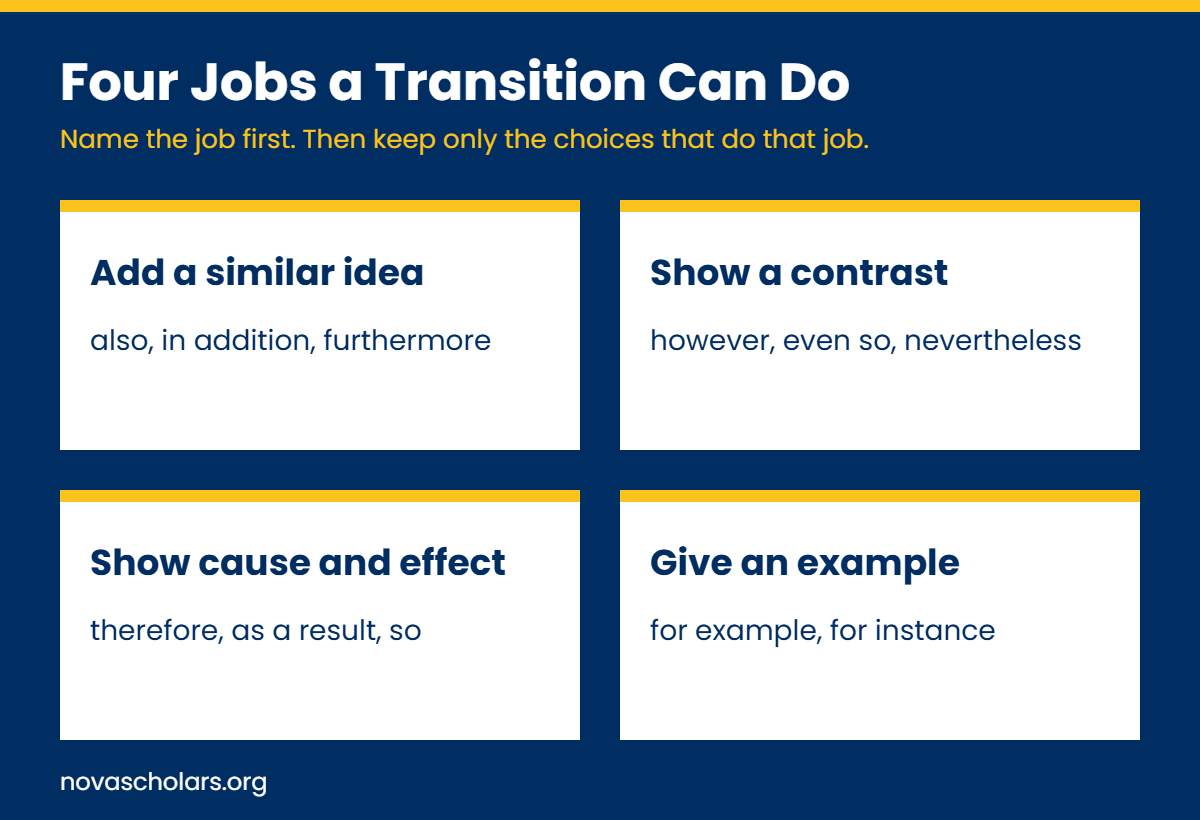
Naming the job before reading the choices keeps your student from being pulled toward a word just because it sounds polished.
What Traps Should Your Student Watch For?
Three traps catch students again and again.
- The word that sounds smart. "Furthermore" and "nevertheless" sound impressive, but a fancy word that does the wrong job is still wrong.
- Two choices that do the same job. If "however" and "nevertheless" are both offered, they say the same thing, so there is rarely a reason to prefer one over the other. Use this as a check after naming the job, not as a replacement for it.
- Skipping NO CHANGE. Keeping the word already in the passage is a real option. If it does the right job, keep it.
Try It: Three Practice Questions
These are new questions written for this post. The underlined part is the part to judge, and NO CHANGE means keep it as written.
1. Maya practiced her trumpet scales every morning for a month. As a result, she played the hardest passage in the spring concert without a mistake.
A. NO CHANGE
B. However,
C. For example,
D. Nevertheless,
Answer: A. A month of practice led to the clean performance, so the job is cause and effect, and "As a result" already does it. Choices B and D signal a contrast, and choice C would make the concert one example of practicing scales, which it is not.
2. The town library spent a whole year advertising its new Saturday story hour. Therefore, only a handful of families came to the first session.
F. NO CHANGE
G. Even so,
H. Similarly,
J. In addition,
Answer: G. A year of advertising should bring a crowd, but only a few families came, so the job is contrast. Choice F says the advertising caused the small turnout, and choices H and J add a matching idea instead of an unexpected one.
3. Some desert plants store water in thick, waxy leaves. However, the jade plant keeps enough water in its leaves to go weeks without rain.
A. NO CHANGE
B. For example,
C. Therefore,
D. Instead,
Answer: B. The jade plant is one case of the plants described in the first sentence, so the job is giving an example. Choices A and D set up a contrast that is not there, and choice C says the jade plant stores water because other plants do.
Sources
- ACT, ACT Exam Sections, Structure and Timing (English question count, time, and reporting categories), checked November 23, 2026.
- The three-step habit, the chart, and the practice questions are Nova Scholars teaching guidance, not ACT content.
Want to See Where Your Student Stands?
My full-length Practice ACT runs under real ACT timing and comes with a score report: an estimated score range for each section, plus the skills and pacing to work on next. It is listed at $55, and it is as low as $5 plus Outschool's marketplace fee, shown at checkout, for families new to Outschool. Book the Practice ACT here.
Full disclosure: I get a referral reward from Outschool when a new family joins through my link.
Daa'iyah Na'im, Ed.S., is a licensed teacher and doctoral candidate researching feedback and ACT Math performance. She founded Nova Scholars, a Mississippi nonprofit, and teaches live ACT prep on Outschool.
Want the next tip in your inbox? Subscribe for free