How Do You Solve ACT Math Probability Questions? Count the Sample Space First
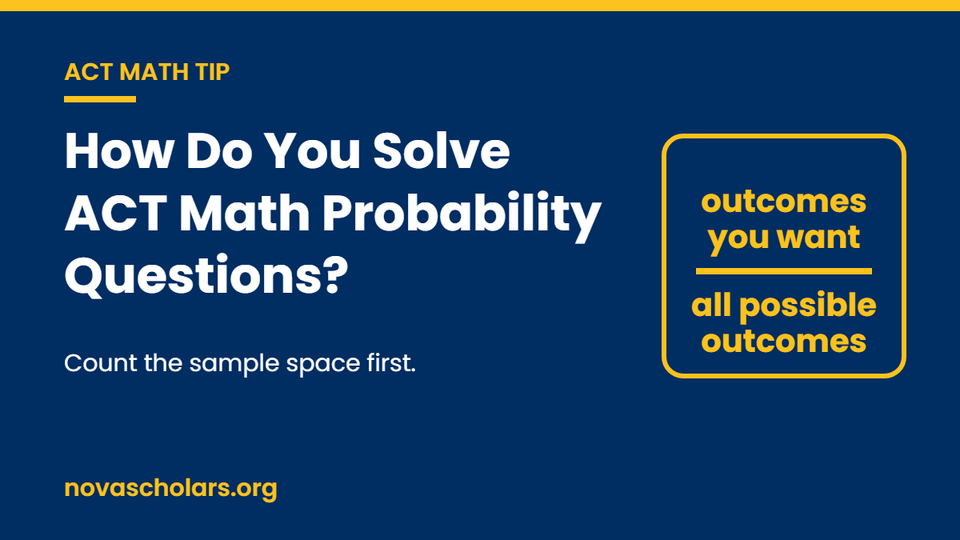
Most ACT Math probability questions come down to one fraction: the number of outcomes you want divided by the number of possible outcomes. The fastest habit is to count the whole sample space (every possible outcome) before you calculate anything.
Probability questions are short, so students tend to rush them, and the wrong answer choices are often built from the most common rushed moves: counting the wrong group, adding when they should multiply, or forgetting that an item drawn out of a bag is not put back. A few rules handle almost all of them.
How Much of ACT Math Is Probability?
ACT lists Statistics and Probability as one part of Preparing for Higher Math, at about 12% to 15% of the math section. ACT says that category includes calculating probabilities along with their sample spaces, plus describing data and relationships in data. Probability is one topic in that group, so expect a few questions, not a whole section.
| ACT Math fact | What ACT lists |
|---|---|
| Questions | 45 (41 scored) |
| Minutes | 50 |
| Average time per question | About 67 seconds |
| Answer choices per question | 4 |
| Statistics and Probability | About 12% to 15% of the section |
Checked at act.org on November 22, 2026. The time per question is our division of 50 minutes by 45 questions.
What Is the One Probability Formula Your Student Needs?
Probability equals the number of outcomes you want divided by the total number of possible outcomes, as long as every outcome is equally likely. The hard part is almost never the division. It is getting the bottom number right.
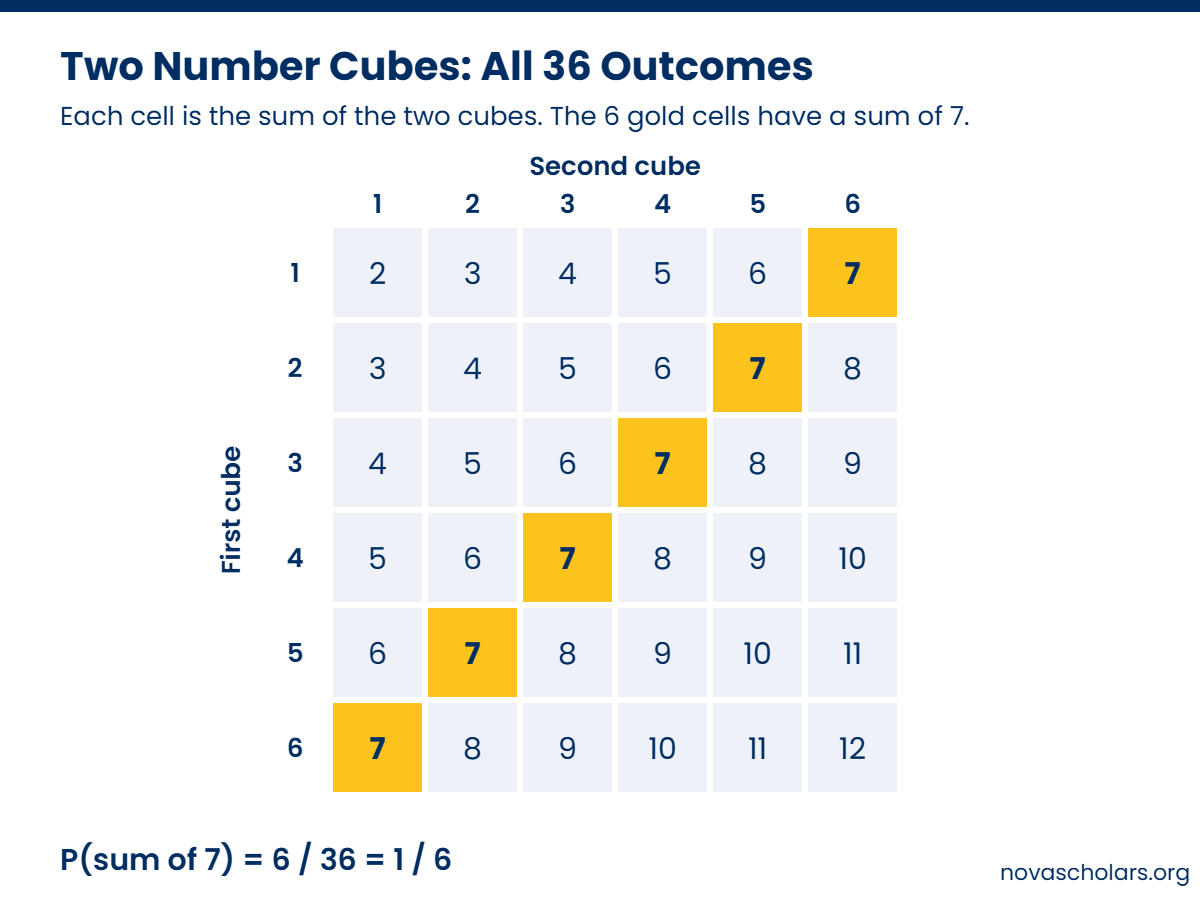
When two things happen at once, such as rolling two number cubes, list the outcomes in a grid instead of guessing. Two cubes give 6 times 6, or 36, equally likely outcomes. A common mistake is to say there are 11 possible sums (2 through 12) and treat them as equally likely, but a sum of 7 can happen six ways while a sum of 2 can happen only one way.
When Do You Multiply and When Do You Add?
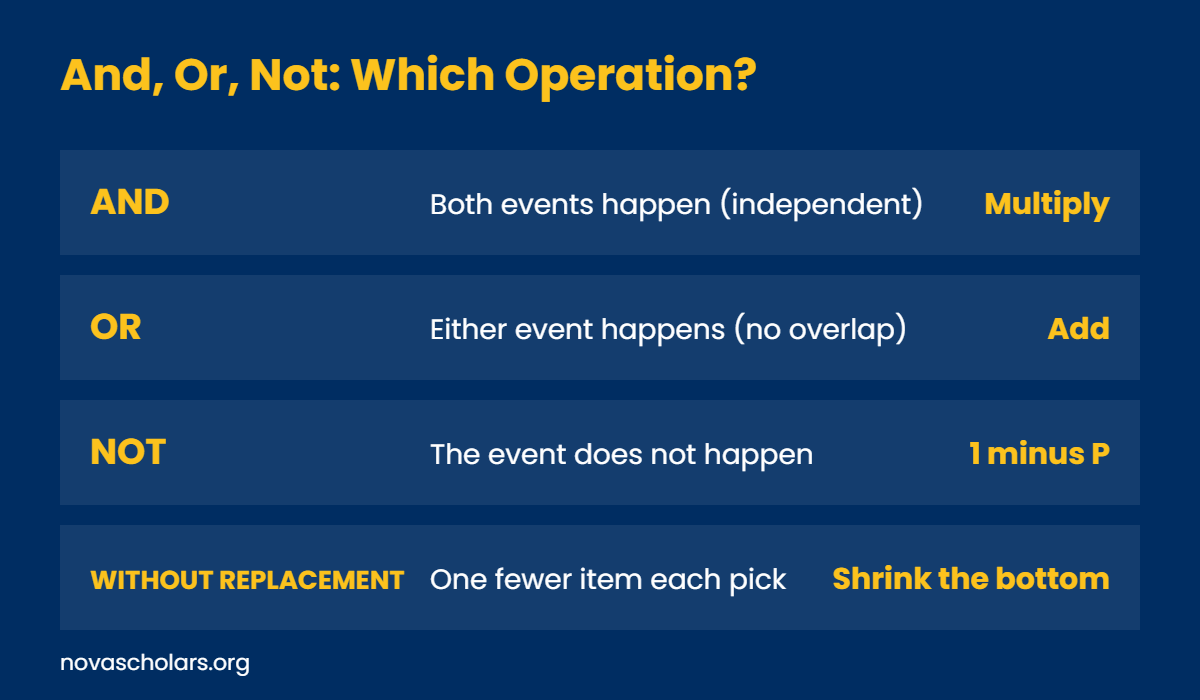
The question's wording tells your student which operation to use. Teach your student to circle the words "and," "or," "not," and "without replacement" before working the problem.
| Wording | What it means | What to do |
|---|---|---|
| And | Both events happen, and one does not change the other | Multiply the probabilities |
| Or | Either event happens, and they cannot both happen | Add the probabilities |
| Not | The event does not happen | Subtract the probability from 1 |
| Without replacement | An item drawn is not put back | Make the second fraction's bottom number one smaller |
What Mistakes Do the Wrong Answers Catch?
Three slips show up again and again. First, answering the wrong question: the problem asks for "not blue," and the student finds the probability of blue. Second, comparing part to part instead of part to whole: 5 blue to 7 other marbles is a ratio, not a probability out of 12. Third, ignoring "without replacement": after one sock leaves the drawer, the drawer holds one fewer sock. Before your student picks an answer, have them say out loud what the bottom of the fraction is counting.
Try It: Three Practice Questions
These are new questions written for this post. ACT Math uses A, B, C, D on odd-numbered questions and F, G, H, J on even-numbered ones, so these follow the same pattern.
1. A bag holds 4 red marbles, 5 blue marbles, and 3 green marbles. One marble is drawn at random. What is the probability that it is NOT blue?
A. 5/12
B. 7/12
C. 5/7
D. 1/3
Answer: B. There are 12 marbles and 7 of them are not blue, so the probability is 7/12. Choice A is the probability of blue, choice C compares blue to the other marbles instead of to all 12, and choice D is the probability of red.
2. Two fair six-sided number cubes are rolled. What is the probability that the sum is 9?
F. 1/18
G. 1/9
H. 1/6
J. 1/11
Answer: G. Four of the 36 outcomes sum to 9 (3 and 6, 4 and 5, 5 and 4, 6 and 3), and 4/36 is 1/9. Choice F counts 3 and 6 as the same outcome as 6 and 3, choice H is the probability of a sum of 7, and choice J treats the 11 possible sums as equally likely.
3. A drawer holds 3 black socks and 2 white socks. Two socks are drawn at random, one after the other, without replacement. What is the probability that both socks are black?
A. 9/25
B. 3/10
C. 3/5
D. 1/10
Answer: B. The first sock is black with probability 3/5, and then 2 of the 4 socks left are black, so 3/5 times 2/4 is 6/20, or 3/10. Choice A puts the first sock back, choice C stops after the first draw, and choice D is the probability that both socks are white.
Can Students Use a Calculator on ACT Math?
Yes. ACT says students may use a calculator on the mathematics section, following its calculator policy, which lists prohibited models and features (checked at act.org on November 22, 2026). Fractions like these are quick by hand, but a calculator helps your student check them. Not sure your student's calculator is allowed? Check our ACT Calculator Policy guide.
Sources
- ACT, ACT Exam Sections, Structure and Timing (question counts and time), checked November 22, 2026.
- ACT, Mathematics Test Description for the ACT (reporting categories, Statistics and Probability, and the calculator note), checked November 22, 2026.
- ACT Student Blog, The Enhanced ACT Explained (four answer choices in math), checked November 22, 2026.
- The counting habit, the two diagrams, and the practice questions are Nova Scholars teaching guidance, not ACT content.
Want to See Where Your Student Stands?
My full-length Practice ACT runs under real ACT timing and comes with a score report: an estimated score range for each section, plus the skills and pacing to work on next. It is listed at $55, and it is as low as $5 plus Outschool's marketplace fee, shown at checkout, for families new to Outschool. Book the Practice ACT here.
Full disclosure: I get a referral reward from Outschool when a new family joins through my link.
Daa'iyah Na'im, Ed.S., is a licensed teacher and doctoral candidate researching feedback and ACT Math performance. She founded Nova Scholars, a Mississippi nonprofit, and teaches live ACT prep on Outschool.
Want the next tip in your inbox? Subscribe for free