How Do You Answer ACT Science Experiment Questions?
To answer an ACT Science experiment question, first find three things: what the scientists changed on purpose, what they measured, and what they kept the same. Then answer from those three things and the data, not from what your student remembers from class.
Many students freeze when a Science passage describes a study with several trials. The fix is a habit your student can practice at home with any experiment, and it takes only a few seconds per passage once it is automatic.
How Much of ACT Science Is About Experiments?
ACT Science is an optional add-on to the ACT. ACT sorts its questions into three groups, and one of them, Scientific Investigation, is about experimental design, including variables and controls, and predicting or extending what an experiment found.
| What ACT Science Measures | Share of the Section |
|---|---|
| Interpretation of Data | 38 to 50 percent |
| Scientific Investigation | 18 to 32 percent |
| Evaluating Scientific Arguments and Models with Evidence | 25 to 35 percent |
| Section | Questions | Minutes | Average per Question |
|---|---|---|---|
| ACT Science | 40 (34 scored) | 40 | About 1 minute |
Checked at act.org on November 14, 2026: What's on the ACT Test? Exam Sections and Structure.
In our experience, many of the tables and graphs in the section also come from a study someone ran. Knowing how the study was set up makes those numbers easier to read.
What Three Things Should Your Student Find in Every Experiment?
Scientists have names for these three things. Your student does not need the vocabulary to reason through an experiment, but it helps to know the words in case a question uses them. Here are the plain meanings:
- What changed on purpose. This is the independent variable: the one thing the scientist set to different values on purpose.
- What was measured. This is the dependent variable: what the scientist watched or recorded to see what happened.
- What stayed the same. These are the controlled variables: everything kept identical in every trial, so any difference in the measurement can be traced back to the one thing that changed.
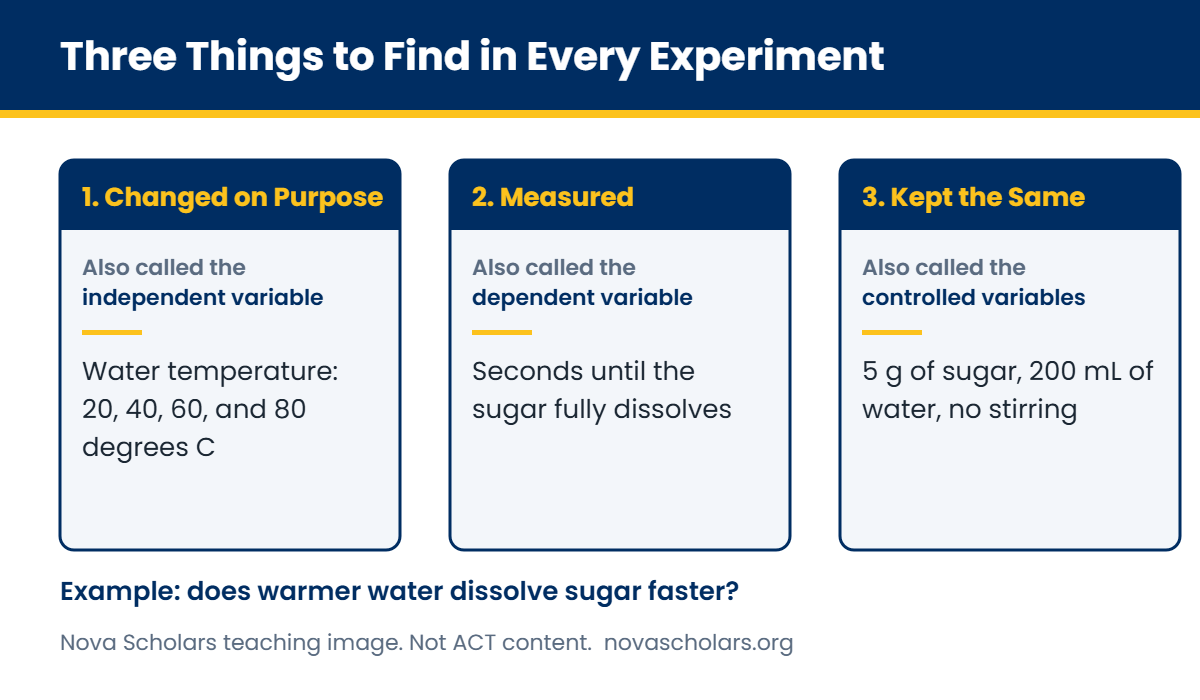
A quick way to find them: the thing that changed is usually listed across the first column or the horizontal axis, the measurement is usually the other column or the vertical axis, and the controls are usually in the sentences that describe how each trial was set up.
What Do ACT Science Experiment Questions Ask?
Most experiment questions come back to the same three parts. In our experience teaching ACT Science, they usually ask your student to:
- Name what was changed or measured in a study.
- Explain why something was kept the same in every trial.
- Pick the new trial that would test a different idea fairly, changing only one thing.
- Predict a measurement for a value between two trials that were actually run.
The fair-test rule answers many of these: a good experiment changes one thing at a time. If an answer choice changes two things at once, it cannot tell you which change caused the difference.
Try It: Four Practice Questions
These questions and this experiment were written new for this post by Nova Scholars. They are not ACT questions.
The experiment. A student put 5 g of sugar into 200 mL of water, did not stir, and timed how long the sugar took to dissolve completely. The student repeated this with water at four temperatures.
| Water Temperature (degrees C) | Time to Dissolve (seconds) |
|---|---|
| 20 | 120 |
| 40 | 80 |
| 60 | 40 |
| 80 | 20 |
1. Which variable did the student change on purpose?
A. The mass of sugar
B. The water temperature
C. The time to dissolve
D. The volume of water
Answer: B. The temperature was set to four different values on purpose. Choice C is what the student measured, and choices A and D stayed the same in every trial.
2. Which of the following was kept the same in every trial?
F. The water temperature
G. The time to dissolve
H. The mass of sugar and the volume of water
J. The temperature at which the sugar dissolved fastest
Answer: H. Every trial used 5 g of sugar and 200 mL of water. Choice F changed on purpose, choice G was the measurement, and choice J is a finding, not a setting.
3. If the student ran one more trial with water at 50 degrees C, the time to dissolve would most likely be:
A. less than 20 seconds.
B. between 40 and 80 seconds.
C. between 80 and 120 seconds.
D. more than 120 seconds.
Answer: B. 50 degrees C falls between the 40 degree trial (80 seconds) and the 60 degree trial (40 seconds), and in this data warmer water always dissolved the sugar faster. Choice C would fit a temperature between 20 and 40 degrees.
4. The student now wants to test whether stirring changes how fast the sugar dissolves. Which plan is a fair test?
F. Stir some cups and not others, with all water at 40 degrees C
G. Stir some cups at 40 degrees C and leave others unstirred at 80 degrees C
H. Stir every cup and use less water in each one
J. Stir every cup and switch from sugar to salt
Answer: F. Only stirring changes, so any difference in time comes from stirring. Choice G changes stirring and temperature at once, so the student could not tell which one made the difference, and choices H and J never compare stirred cups with unstirred ones.
How Should Your Student Practice This at Home?
Have your student practice the three labels until they happen without thinking:
- Label first. Before reading any question, your student writes C (changed), M (measured), and S (same) next to the matching words in the experiment description.
- Use everyday studies. A science fair project, a news story about a medical study, or a cooking test at home all have the same three parts. Ask your student to name them out loud.
- Check every answer choice for two changes. On fair-test questions, cross out any choice that changes more than one thing.
- Practice under time. With about a minute per question, the labels have to be fast. Timed practice shows whether they are.
Sources
- ACT, What's on the ACT Test? Exam Sections and Structure (Science: 40 questions, 34 scored, 40 minutes; the three Science reporting groups and their shares; Science is optional). Checked November 14, 2026.
- ACT, Register for the ACT (Science is an add-on test). Checked November 14, 2026.
- The experiment, image, practice questions, and the list of common question kinds are Nova Scholars teaching material, not ACT content.
Want to See Where Your Student Stands?
My full-length Practice ACT runs under real ACT timing and comes with a score report: an estimated score range for each section, plus the skills and pacing to work on next. It is listed at $55, and it is as low as $5 plus Outschool's marketplace fee, shown at checkout, for families new to Outschool. Book the Practice ACT here.
Full disclosure: I get a referral reward from Outschool when a new family joins through my link.
Daa'iyah Na'im, Ed.S., is a licensed teacher and doctoral candidate researching feedback and ACT Math performance. She founded Nova Scholars, a Mississippi nonprofit, and teaches live ACT prep on Outschool.
Want the next tip in your inbox? Subscribe for free