Do You Need to Know Science Facts for ACT Science?
No, your student does not need to memorize advanced science facts for ACT Science: ACT says advanced knowledge is not required, though background knowledge from general, introductory science courses may be needed for some questions.
That one sentence surprises a lot of families. Students often picture ACT Science as a chemistry or physics exam and spend weeks on flashcards. The section is built mostly around reading tables, graphs, and experiments, so the best prep is learning to find the answer in what the test shows you, with a short review of the basics for the few questions that reach past the page.
What Does ACT Say About Science Knowledge on the Test?
ACT's Science test description says the content includes biology, chemistry, Earth and space sciences, and physics, that advanced knowledge in these areas is not required, and that background knowledge from general, introductory science courses may be needed to answer some questions. Its largest reporting category, Interpretation of Data, is about reading tables, graphs, and diagrams (checked at act.org on November 18, 2026).
| ACT Science fact | What ACT lists |
|---|---|
| Questions | 40 (34 scored) |
| Time | 40 minutes, about 60 seconds a question |
| Required? | No, ACT lists Science as optional |
| Subjects | Biology, chemistry, Earth and space sciences, physics |
| Interpretation of Data | 38 to 50 percent of the section |
| Scientific Investigation | 18 to 32 percent |
| Calculator | Not permitted on Science |
Checked at act.org on November 18, 2026, on ACT's Science test description and its exam sections and structure page. The 60 seconds is simple division (40 minutes for 40 questions), and it includes reading the passage.
Which Basic Science Ideas Are Worth Reviewing?
ACT does not publish a list of facts to know. In my teaching, these intro-course ideas are the ones students most often wish they had refreshed. Treat this as a short review list, not a memorization project:
- Variables. The independent variable is what the scientist changes; the dependent variable is what gets measured; a control is kept the same for comparison.
- States of matter. At sea level, pure water freezes at 0 °C and boils at 100 °C, and its temperature stays level while it is changing state.
- pH. Below 7 is acidic, 7 is neutral, and above 7 is basic.
- Density. Density is mass divided by volume, and a less dense object floats on a denser liquid.
- Metric prefixes. Kilo means 1,000, centi means one hundredth, and milli means one thousandth.
- Living things. Plants use photosynthesis to make sugar from carbon dioxide and water using light, and cells release energy from food through respiration.
One evening with a general science review covers this list. Time beyond that is better spent on timed practice reading real-looking data.
How Can Your Student Tell When a Question Needs Outside Knowledge?
Teach your student to reach for outside knowledge last, not first. Here is the order I use:
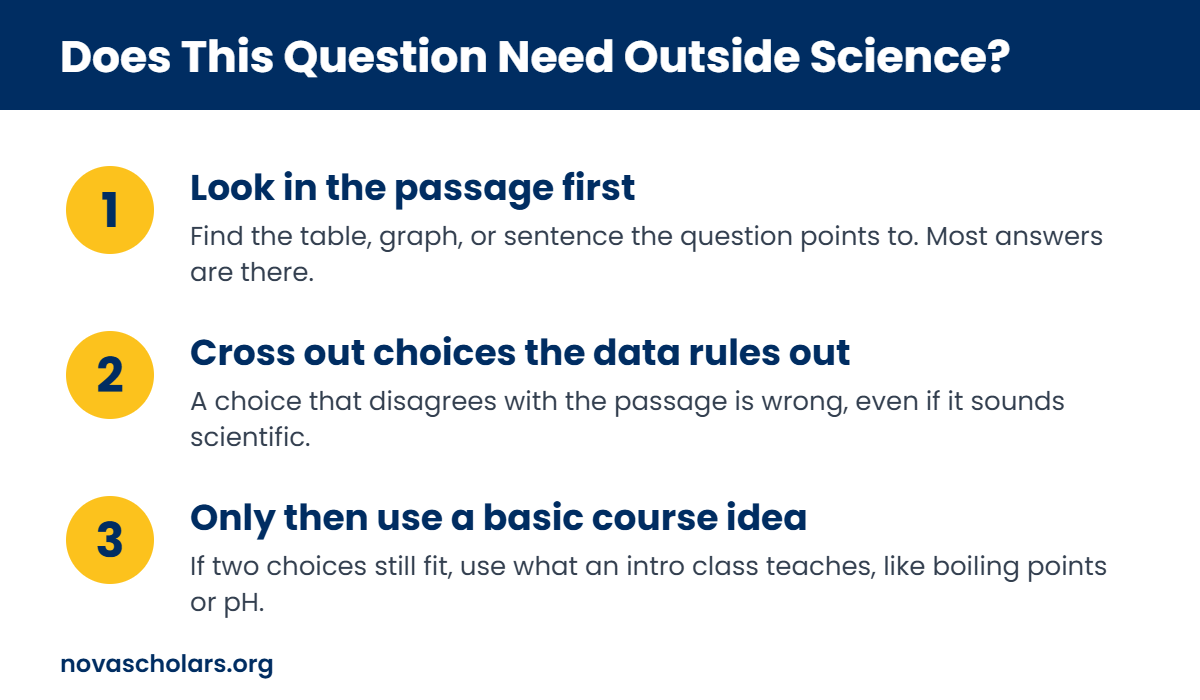
The most common mistake I see is a student who knows some science picking a choice that sounds right from class but does not match the passage. On ACT Science, the passage wins. If a choice disagrees with the data on the page, it is wrong, no matter how scientific it sounds.
Try It: Two New Practice Questions
This short experiment and these questions were written for this post. The first is answered from the table alone. The second needs one basic idea from an intro course.
A student placed 200 g of water in a beaker on a hot plate at sea level and recorded the water's temperature every 2 minutes.
| Time (min) | Temperature (°C) |
|---|---|
| 0 | 20 |
| 2 | 45 |
| 4 | 70 |
| 6 | 95 |
| 8 | 100 |
| 10 | 100 |
1. Based on the table, the water's temperature at 3 minutes was most likely closest to:
A. 45 °C
B. 58 °C
C. 70 °C
D. 95 °C
Answer: B. From 2 to 4 minutes the temperature rose steadily from 45 °C to 70 °C, so at 3 minutes, halfway through that stretch, it was about halfway between them, near 58 °C. A and C are the readings at 2 and 4 minutes, not between them. D is the reading at 6 minutes. No outside science was needed.
2. Which of the following best explains why the temperature stayed at 100 °C from 8 to 10 minutes?
F. The water reached its boiling point, so the added heat went into turning liquid water into steam.
G. The water reached its freezing point, so it began to turn into ice.
H. The hot plate stopped adding heat to the beaker after 8 minutes.
J. The water gained mass, so it needed more heat to warm up.
Answer: F. This is the intro-course idea: at sea level water boils at 100 °C, and its temperature stays level while it boils. G names the wrong change of state. H is not supported, since nothing in the description says the hot plate turned off. J is not supported either; water does not gain mass by heating, and some leaves as steam.
Can Students Use a Calculator on ACT Science?
No. ACT's Science test description says calculators are not permitted in the science section (checked at act.org on November 18, 2026). Any math on Science, like the estimate in question 1, is meant to be done by reasoning or by hand. For the Math section's calculator rules, see our ACT Calculator Policy guide.
Sources
- ACT, Science Test Description for the ACT (content areas, advanced knowledge not required, introductory background knowledge for some questions, reporting categories, no calculator). Checked November 18, 2026.
- ACT, ACT Exam Sections, Structure and Timing (Science optional, 40 questions, 34 scored, 40 minutes). Checked November 18, 2026.
- The review list, the three-step check, the chart, and the practice experiment and questions are Nova Scholars teaching material, not ACT content.
Want to See Where Your Student Stands?
My full-length Practice ACT runs under real ACT timing and comes with a score report: an estimated score range for each section, plus the skills and pacing to work on next. It is listed at $55, and it is as low as $5 plus Outschool's marketplace fee, shown at checkout, for families new to Outschool. Book the Practice ACT here.
Full disclosure: I get a referral reward from Outschool when a new family joins through my link.
Daa'iyah Na'im, Ed.S., is a licensed teacher and doctoral candidate researching feedback and ACT Math performance. She founded Nova Scholars, a Mississippi nonprofit, and teaches live ACT prep on Outschool.
Want the next tip in your inbox? Subscribe for free